Rare rainfall event tops up Cape Town dams to 70,8% in just one week
22 May 2026
Cape Town dam levels increased by about 20% in one week due to the recent, uncommon rainfall event. Extreme rainfall of this kind is likely only to happen every 20 to 200 years in several of the affected catchments. With our current dam levels at 70,8% on Monday, 18 May 2026, Cape Town is now exiting the ‘early drought caution’ stage, but residents are still reminded to remain water wise and always use water responsibly – regardless of how much water is in our dams. To see questions and answers about our water status going forward.
Dam levels and water usage
-
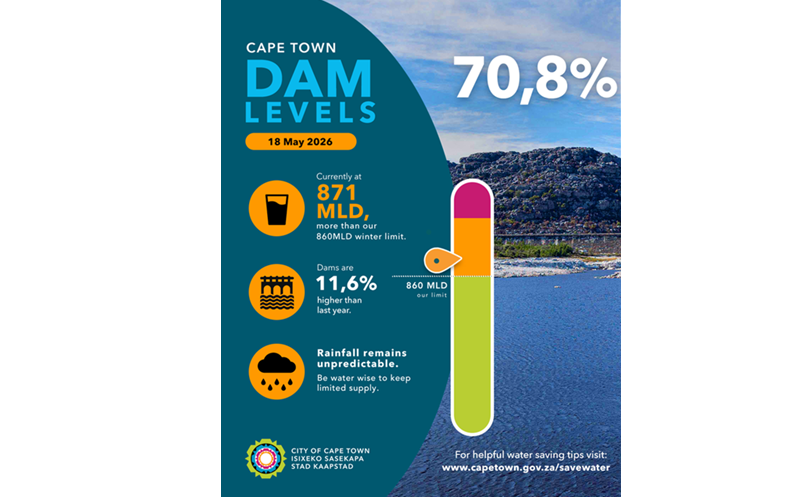
Current dam levels are 70,8% as of Monday, 18 May 2026.
This is an increase of 19,9% compared to the previous week.
This is 11,6% more compared to the same time last year, which was 59,2%. -
Water usage has increased to 871 million litres of water a day (MLD) from 831 MLD last week. This is 11 MLD above the winter usage target of 860 MLD.
Be water wise even when dams are fuller
‘Even though this extraordinary rainfall event has been key to filling our dams by almost 20% in a week, we still need to be water wise. We don’t know when we will get rain again, and if it comes, how much we will get and if it is going to fall in the right place – in the catchment areas of dams – so dam levels can increase.
‘An event such as this does not mean the rest of the year will experience above average rainfall.
‘Climate change is affecting weather patterns and rainfall, so this underscores the City’s investment in our water-secure future. Cape Town is busy working towards diverse water sources in the long-term so that we can depend less on rain-fed dams for our supply. We cannot depend on unpredictable rainfall to fill our dams.
‘Thank you, Team Cape Town for journeying with us over the past few months and heeding the call to save water – we appreciate your contribution. Let’s continue to be water wise. Every drop counts when facing the unpredictable rainfall,’ said Councillor Zahid Badroodien, Mayoral Committee Member for Water and Sanitation.
Frequently Asked Questions
1. Why was May’s rainfall an extraordinary event?
- The exceptional rainfall during May 2026 resulted in the Western Cape Water Supply System (WCWSS) storage or
dam levels increasing and recovering by 20% within one week. This increases the likelihood of the system, which supplies various municipalities with water, reaching full supply capacity (or at least 80%) by November 2026.
-
Rainfall intensities in several catchment areas were so extreme that it is likely only to happen every 20 to 200 years in these affected regions.
2. Why is the City moving out of the ‘early drought caution’ stage?
The City is guided by our Drought Framework Management. In this case, considering our dam levels are now above 70% our water status is moving back to the water-wise stage.
The City will, however, continue to closely monitor dam levels and water use over the coming months.
A reminder:
The City may, based on its own assessments of water usage, dam levels and long-term weather forecasts, propose water restrictions before the next Annual Operating Analysis (AOA) by the National Department of Water and Sanitation (DWS) in November.
Typically, dam levels need to be 80% or more by the time the AOA is done to avoid DWS implementing water restrictions to a municipality.
3. Now that dam levels are more than 70%, must we still save water?
Yes. Cape Town is in a water scarce region and rainfall patterns are unpredictable because of climate change. This past extraordinary rainfall event is an example of this.
The water we currently have in our dams will need to last us until next year, without depending on unpredictable rainfall this year.
While we appreciate the rain that fills our dams, we cannot allow this to give us a false sense of water security for the future. This is because we need more than just dams to ensure our water supply is resilient for years to come (as seen during the drought) to help navigate future climate shocks. The City is investing in our water secure future through our New Water Programme.
Overall, it's important that all of us continue to use water wisely at all times, regardless of the season or dam levels, and even when it rains, as this is a precious resource and it should not be wasted.
Saving water at your fingertips
Some 70% of water being used in high volumes is at home, according to consumption statistics.
Read our top water saving tips on the City's website.
4. What is the City’s Water and Sanitation Directorate doing to be water-wise while building Cape Town’s water secure future?
Since the drought, the City has – and continues to – proactively invest in annually upgrading aged water pipes, improving pressure management, fixing leaks faster and strengthening metering along the water supply network.
The City is also actively investing and progressing with strategic plans for Cape Town’s new water supply to build our water secure future, which aims to add 300 million litres a day to our water supply. This includes projects such as desalination, groundwater schemes and reuse.
Remember to report burst municipal pipes immediately to the City’s formal channels:
Please provide an exact location or address and always insist on a reference number.
Caption 1: Dam levels infographic update for 19 May 2026.
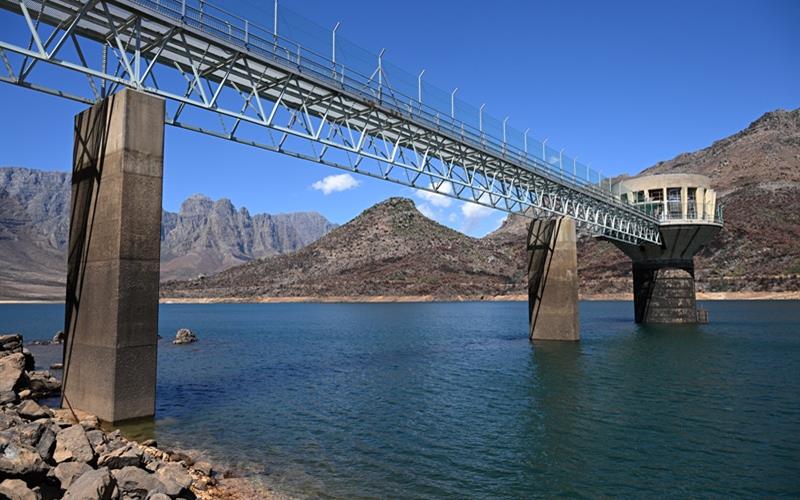
Caption 2: Wemmershoek Dam in February 2026.
End
Published by:
City of Cape Town, Media Office